
CheqOne updates
Secure Online Cheque Printing UAE That Stays Controlled
Secure online cheque printing UAE teams can trust, with precise layouts, bilingual amounts, permissions, audit trails, and full cheque lifecycle visibility.
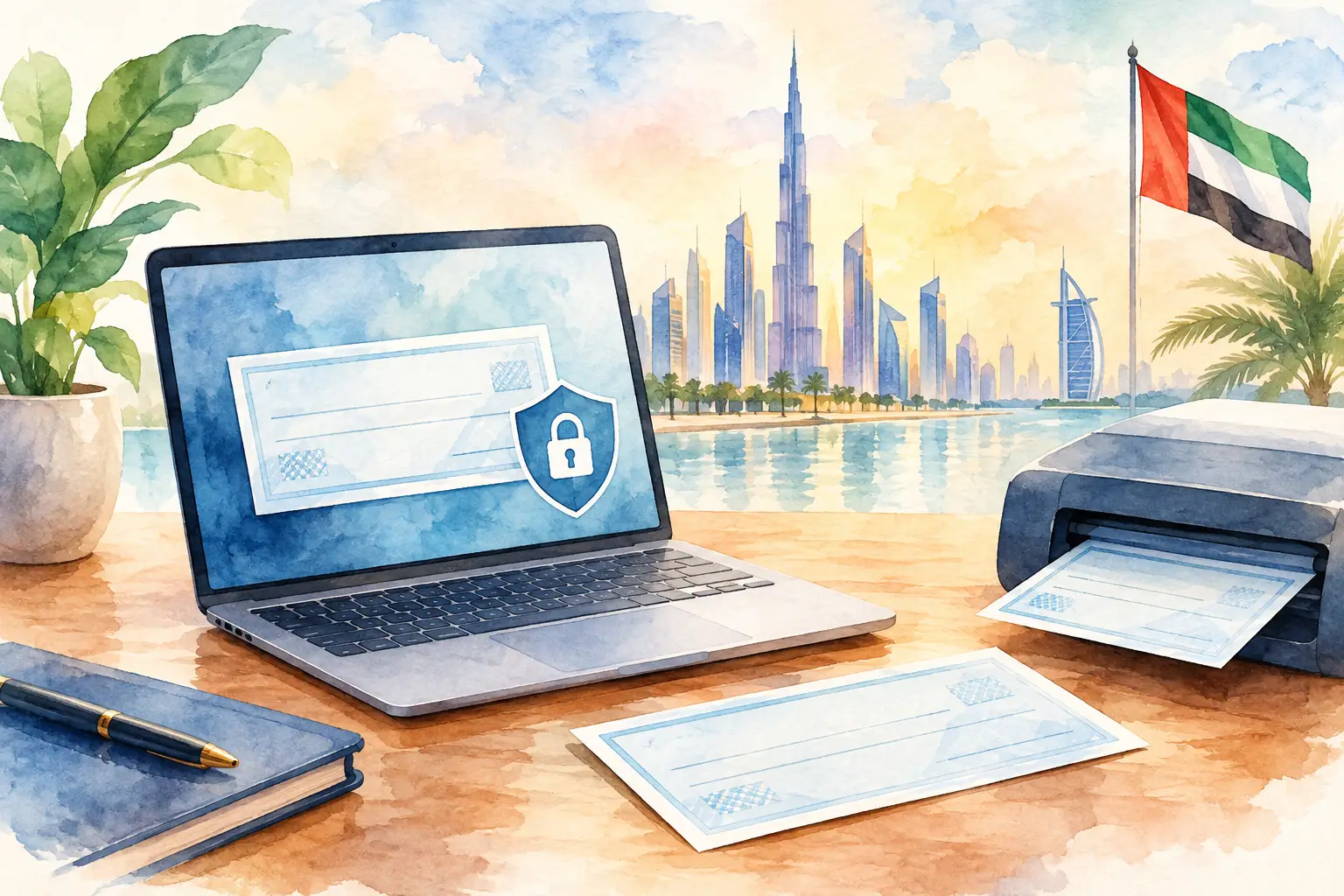
A cheque can be correctly approved and still create a payment-control problem at the last step. The wrong leaf may be used, a date may be missed, the print may drift into the amount field, or no one may be able to confirm what happened after delivery. Secure online cheque printing UAE businesses need is not simply a way to put text on a cheque. It is a controlled process from request to final status.
For finance teams managing supplier payments, rents, installments, and post-dated cheques, the physical cheque remains a high-value payment instrument. That makes accuracy, access control, and traceability part of the printing process, not separate administrative tasks.
What secure online cheque printing should control
A browser-based cheque system should create a reliable record before a printer is involved. Each payment needs a clear link to its company, bank account, cheque book, leaf number, payee, amount, date, and creator. If any of those details are unclear or editable without a record, the team is still relying on informal controls.
Security also means preventing accidental conflicts. A finance user should not discover after printing that the same cheque number was already recorded, that the selected cheque book has run out of leaves, or that the bank account does not match the intended payment. These are ordinary operational risks, especially where several people handle payments or multiple entities share a finance function.
The best systems apply controls quietly in the background. They preserve the register, track the next available leaf, and retain a history of changes so the team can work quickly without losing accountability.
Start with a controlled cheque register
A cheque register is the operating record behind every printed leaf. It should be established before the first cheque is created, with each legal entity, bank account, cheque book range, and authorized user defined in the system.
This matters most for businesses that manage more than one company or bank account. A spreadsheet may appear adequate when volumes are low, but it becomes fragile when one employee is updating payment details, another is preparing post-dated cheques, and a third is checking whether an older cheque cleared. Version confusion is not a minor inconvenience when physical payment instruments are involved.
A centralized register gives each cheque a consistent lifecycle. Common statuses include issued, delivered, honored, dishonored, canceled, and post-dated. The status should reflect the actual position of the cheque, rather than forcing staff to search emails, file notes, or separate spreadsheets to reconstruct it.
Treat cheque leaves as controlled inventory
Unused cheque leaves should be tracked by book and number range. This enables the system to identify which leaf is available, which leaves have been printed, and which may have been voided or canceled. It also helps finance teams investigate gaps without guesswork.
For example, if a cheque is printed incorrectly because the paper was loaded upside down, the original leaf should not simply disappear from the process. It should be marked appropriately, retained in the register, and replaced with the next controlled leaf. That record protects both the company and the staff member handling the print job.
Make access match financial responsibility
Not every user needs the same level of control. A practical secure online cheque printing workflow separates preparation, approval, printing, and administrative setup where the business requires it. The right structure depends on payment volume and internal policy, but unrestricted shared access is rarely appropriate.
Role-based permissions can limit who creates cheques, who changes bank settings, who manages cheque books, and who can access reports. This is particularly valuable for group administrators overseeing several companies. They need visibility across the portfolio, while local users may need access only to their own entity or bank account.
Audit trails add the second layer of assurance. A useful record captures who created or edited a cheque, what changed, and when the action occurred. It is not designed to slow the team down. It gives finance managers a clear answer when they need to review an exception, respond to an audit question, or reconcile a disputed payment.
A shared login cannot provide that clarity. Individual user access is the more dependable foundation, even for a small team.
Printing accuracy is a security issue too
Cheque printing is unusually sensitive to layout. A payee name that runs into the wrong area, a numeric amount that shifts, or a date that lands outside a bank's expected field can result in a rejected cheque or an avoidable replacement process.
That is why precise alignment controls matter. The software should use a bank-specific layout and allow fine adjustments for the selected printer. A setting as small as 0.1 mm can be meaningful when matching a printed cheque design. It is also important that the layout supports the printer the office already uses, whether that is a laser, inkjet, dot-matrix, or dedicated cheque printer.
A secure workflow does not mean every device should be allowed to print. Businesses should designate approved printer PCs, test each bank layout with the actual printer, and keep the configuration controlled. A user may prepare a cheque in the browser, while a local print helper handles the exact communication with the approved Windows printer.
This approach balances cloud access with physical-printing control. Finance can work from one central workspace, while the final cheque is printed only through a configured device.
Use bilingual amount wording without manual translation
For UAE and GCC cheque operations, amount wording is a common point of avoidable risk. Manually typing words in English and Arabic consumes time and introduces spelling, grammar, and formatting inconsistencies.
The system should generate the amount in words from the numeric value, in both languages, using the chosen currency conventions. Users should still review the complete cheque before printing, but they should not have to rely on manual bilingual conversion for every payment. Correct wording supports clearer documentation and reduces one more source of rework.
Plan post-dated cheques as future obligations
Post-dated cheques are not finished when they leave the printer. They represent dated commitments that need visibility until they are honored, replaced, or canceled. A payment file that records only the issue date cannot provide the planning view treasury and accounts payable teams need.
The register should make future-dated cheques easy to filter, report, and review by due date, company, bank account, payee, or status. Batch creation is equally useful where a business prepares a series of installment, rent, or supplier cheques with recurring dates and amounts. The goal is not just faster entry. It is a clearer view of upcoming cash commitments.
When a cheque is delivered, dishonored, or canceled, update the status promptly. Delayed status updates create a false picture of cash exposure and make month-end reconciliation harder than it needs to be.
A practical setup process for finance teams
A controlled system should be straightforward to introduce. Start by adding each company and bank account, then register the active cheque books with their ranges. Next, assign users and permissions based on actual responsibilities. Finally, configure and test the printer against each required bank layout before live payments begin.
Historical data should not be left behind if it is needed for reconciliation or reporting. Importing existing cheque records gives the team continuity from the first day and avoids maintaining two registers during transition.
CheqOne supports this operating model with regional bank layouts, a layout designer for additional formats, English and Arabic amount wording, controlled printing through its Windows Print Helper, and lifecycle tracking in one calm place for every company. The useful question is not whether a team can print a cheque online. It is whether every printed cheque remains accountable afterward.
Questions to ask before choosing a platform
Before moving away from handwriting, spreadsheets, or older desktop tools, confirm how the system handles everyday exceptions. Can it prevent duplicate cheque numbers? Can it track voided leaves? Can it separate access across companies and bank accounts? Can it record delivery and final payment status? Can it support the bank formats and printers already in use?
Also ask how the team will handle a reprint, a damaged cheque leaf, or a payment that is canceled after approval. A platform earns trust in these less-than-perfect moments, not only when the first print comes out correctly.
A dependable cheque process gives finance teams more than clean printouts. It gives them a current, defensible record of every payment instrument in circulation, so the next cheque can be issued with the same care as the last.